
Inner Child Therapy for Attachment Issues:
How healing your inner child can help you overcome emotional struggles in relationships

What are attachment issues and how do they show up in relationships?
If you struggle with low self-esteem in relationships or find yourself pushing others away, you might have some attachment issues which could be helped with Inner Child Therapy.
Unhealed attachment wounds can ripple into all areas of life. Romantic relationships can become such a rollercoaster of anxiousness that love feels so painful you might wonder if it is possible for you.
Fearing rejection, you might cling to your partner or spiral into panic that they will lose interest in you as soon as they leave the house. Or you might find yourself repeating patterns of avoidance, never quite feeling safe enough to let someone get close to you out of fear of getting hurt or being seen as unworthy.
But it isn’t just romantic relationships that can feel like a struggle. Friendships might feel unreliable or filled with tension. You might worry that people don’t like you or that they say bad things as soon as you leave the room. Even professional relationships and job opportunities can suffer due to trust issues or fear of judgement or criticism.
These patterns can push away the people you desire connection with, creating the very situations you are trying to avoid. But these are not things you are doing by choice; they are “protective” strategies formed early in childhood due to unmet emotional needs.
This is where Inner Child Therapy can help. With guided support, you can replace these survival strategies with an ability to self-soothe and regulate difficult emotions. You can build your sense of worth and self-esteem, giving you the confidence to choose healthy relationships and walk away knowing you will cope on your own, and not push people away out of fear.
Diagram of The Inner Child Parts
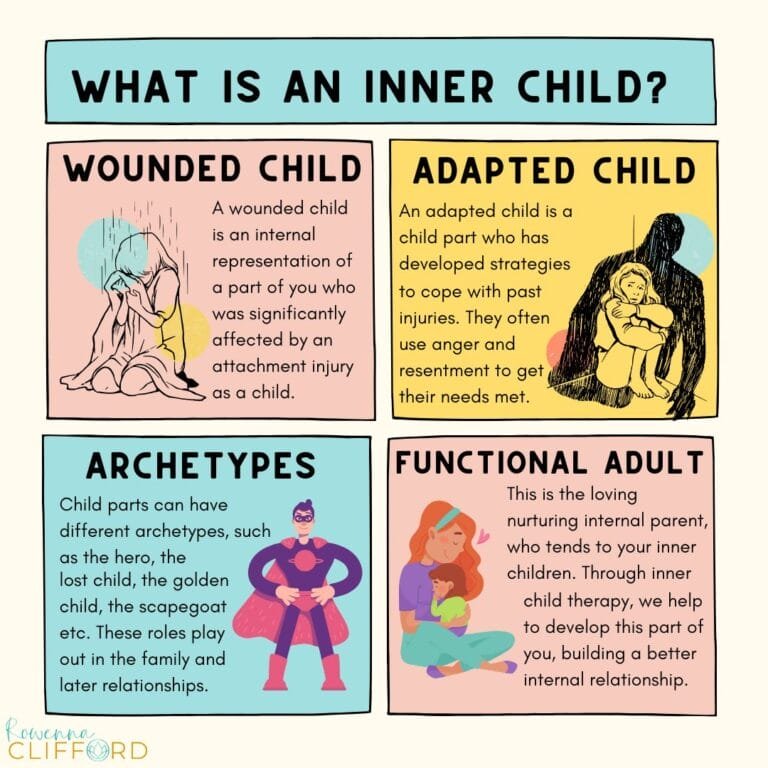
How Inner Child Therapy Works to Heal Your Attachment Issues
Inner Child Therapy can help you work through attachment issues by connecting you with the younger parts of yourself that were hurt or neglected. Through powerful therapeutic techniques using guided visualisation and dialogue with your inner child, you can:
- Release limiting beliefs rooted in childhood experiences
- Rebuild a sense of safety and trust within yourself
- Develop secure, healthy ways of connecting with others
- Reduce relationship anxiety and fear of rejection
- Learn to express yourself more clearly and set healthy boundaries
- Cultivate self-compassion and emotional resilience
- Regulate your emotions and let go of obsessive or acting out behaviours
This therapy goes beyond managing symptoms — it helps you revisit and transform the core wounds themselves. We do this by helping you provide your inner child the love and validation they missed out on in early life. This experience creates profound healing, helping you to ease emotional triggers and develop a sense of security inside yourself.

Signs you may have attachment issues:
- Overwhelming fear of being abandoned or rejected
- Difficulty trusting those close to you
- Becoming overly dependent on partners or friends
- Anxiety when loved ones seem distant
- Struggling with self-worth or feeling unlovable
- Trouble setting boundaries or saying no
- Pulling away before others can leave you
- Perfectionism driven by fear of not being enough
- People-pleasing to avoid disapproval
- Feeling deeply defective or undeserving of love
Types of Attachment Injuries
Attachment injuries can vary widely depending on the circumstances of childhood experiences. Some common types include:
- Emotional neglect: When a child’s feelings, thoughts, or presence are routinely ignored or minimised.
- Physical absence or loss: Separation from a caregiver due to death, divorce, imprisonment or long hospital stays.
- Inconsistent caregiving: Caregivers who are unpredictable in their affection or responses, creating insecurity.
- Parental mental illness or addiction: Environments where caregivers are emotionally unavailable or unreliable.
- Trauma or abuse: Experiences of harm or fear in the caregiving environment.
- Overprotection or enmeshment: When boundaries are blurred, and the child feels responsible for the caregiver’s feelings.
Even unintentional forms of rejection, such as a caregiver overwhelmed by their own stresses, can imprint deep feelings of being unimportant or unsafe.
One of the great things about Inner Child Therapy, is that you don’t even need to remember specific memories. Together, we can locate the child parts of you that carry certain emotions and beliefs that get triggered and help you tend to their needs now.
This therapeutic process helps retrain your nervous system to respond to triggers in a different way. By teaching your inner child parts that you have the tools to help them, you’ll learn to self-regulate. This helps you learn to soothe your emotional system in ways that you missed out on in childhood.
How Inner Child Therapy for Attachment Issues Transformed My Own Life

Before I experienced Inner Child Therapy myself, my relationships were a mess. I spent many years in and out of unhealthy relationships, choosing partners who rejected me or had little respect for my boundaries.
I used people pleasing strategies to try and make myself so useful that they couldn’t live without me. And I sacrificed my own needs and desires for commitment in order to look cool or not be “too needy”.
And it wasn’t just my romantic life that was affected. I struggled to feel safe in friendships, believing that people didn’t like me or that they would reject me if I let them see the “real me”. I burned myself out with people pleasing behaviours in attempts to be seen as “valuable” or worth keeping around.
Of course, none of these attempts to get the love and validation I wanted worked and eventually lead to the relationships breaking down, or me feeling rejected all over again.
That’s why I know how painful these kinds of attachment issues can be. Many nights, I found myself crying into my pillow, wondering what I was doing wrong and if there was something “bad” about me that made me unlovable.
When I Reached Out For Help
Finally, I realised that I needed help to change these patterns and thankfully, I came across Inner Child Therapy.
It was such a relief to find out that I wasn’t “unlovable” or “bad”, for feeling this way, and that I had a way to connect with and support those parts of myself that were being triggered.
Through gentle and skilful guidance from my therapist, I was able to work through painful memories and beliefs connected with my childhood and release old emotions that were holding me back.
Now, I’m able to connect with people in a more authentic way, speak up for myself without fear of rejection and walk away from situations that are unhealthy for me. I no longer seek validation from others, and I know that I am worthy, no matter what other people think of me.
Many people who experience Inner Child Therapy for attachment issues report profound shifts, such as:
- Feeling calmer and less anxious when a partner is distant temporarily.
- Increased confidence to express needs and boundaries without guilt.
- Greater ability to trust both themselves and others.
- Awareness of unhealthy relationship patterns and the tools to change them.
- A deeper sense of self-love that attracts healthier relationships.
Imagine no longer being caught in the exhausting cycle of fearing abandonment but instead trusting that you are enough exactly as you are!
Inner Child Therapy helped me to overcome my own struggles with attachment issues, and I’ve now helped hundreds of other people do the same.
Whether you know what past experiences have created attachment issues for you or not, we can work with the child parts of you that show up as anxiety or avoidance now.
Starting Your Healing Journey with Inner Child Therapy
Healing attachment wounds takes courage, but with professional Inner Child Therapy, it is entirely possible to transform your emotional world. Whether you experienced neglect, loss, inconsistency, or trauma in childhood, you can learn to nurture your inner child and build secure, loving relationships as an adult.
If you’re ready to start your healing journey and reclaim your self-esteem in relationships, get in touch to see how Inner Child Therapy can help you move forward and build a better life.